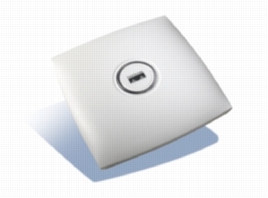
| item |
Specification |
| Part number |
• AIR-AP1131G-x-K9 (Cisco IOS Software)
• AIR-LAP1131G-x-K9 (Cisco Unified Wireless Network Software)
Note: The Cisco Aironet 1130G Series can be ordered with Cisco IOS Software to operate as an autonomous access point with Cisco Unified Wireless Network Software using LWAPP. When the access point is operating as a lightweight access point, a WLAN controller is required.
• Regulatory domains: (x = Regulatory domain)
• A = FCC
• E = ETSI
• P = Japan2
Customers are responsible for verifying approval for use in their individual countries. To verify approval and to identify the regulatory domain that corresponds to a particular country, please visit: http://www.cisco.com/go/aironet/compliance.
Not all regulatory domains have been approved. As they are approved, the part numbers will be available on the Global Price List. |
| Data rates supported |
802.11g: 1, 2, 5.5, 6, 9, 11, 12, 18, 24, 36, 48, and 54 Mbps |
| Network standard |
IEEE 802.11b and 802.11g |
| Uplink |
Autosensing 802.3 10 and 100BASE-T Ethernet |
| Frequency band and operating channels |
Americas (FCC)
• 2.412 to 2.462 GHz; 11 channels
• ETSI
• 2.412 to 2.472 GHz; 13 channels
Japan (TELEC)
• 2.412 to 2.472 GHz; 13 channels Orthogonal Frequency Division Multiplexing (OFDM)
• 2.412 to 2.484 GHz; 14 channels Complementary Code Keying (CCK)
• 5.15 to 5.25 GHz; 4 channels
Japan-P (TELEC 2 (Japan2) Cnfg)
• 2.412 to 2.472 GHz; 13 channels Orthogonal Frequency Division Multiplexing (OFDM)
• 2.412 to 2.484 GHz; 14 channels Complementary Code Keying (CCK)
• 5.15 to 5.35 GHz, 8 channels
Japan-Q
• 2.412 to 2.472 GHz; 13 channels Orthogonal Frequency Division Multiplexing (OFDM)
• 2.412 to 2.484 GHz; 14 channels Complementary Code Keying (CCK)
• 5.15 to 5.35 GHz; 8 channels
• 5.470 to 5.725 GHz; 11 channels |
| Nonoverlapping channels |
802.11b/g: 3 |
| Receive sensitivity (typical) |
802.11g:
• 1 Mbps: -93 dBm
• 2 Mbps: -91 dBm
• 5.5 Mbps: -88 dBm
• 6 Mbps: -86 dBm
• 9 Mbps: -85 dBm
• 11 Mbps: -85 dBm
• 12 Mbps: -84 dBm
• 18 Mbps: -83 dBm
• 24 Mbps: -79 dBm
• 36 Mbps: -77 dBm
• 48 Mbps: -72 dBm
• 54 Mbps: -70 dBm |
| Available transmit power settings (maximum power setting varies by channel and according to individual country regulations) |
802.11b:
CCK:
• 20 dBm (100 mW)
• 17 dBm (50 mW)
• 14 dBm (25 mW)
• 11 dBm (12 mW)
• 8 dBm (6 mW)
• 5 dBm (3 mW)
• 2 dBm (2 mW)
• -1 dBm (1 mW) |
802.11g:
OFDM:
• 17 dBm (50 mW)
• 14 dBm (25 mW)
• 11 dBm (12 mW)
• 8 dBm (6 mW)
• 5 dBm (3 mW)
• 2 dBm (2 mW)
• -1 dBm (1 mW) |
| Range |
Indoor (distance across open office environment): |
Outdoor: |
| 802.11g:
• 100 ft (30m) @ 54 Mbps
• 175 ft (53m) @ 48 Mbps
• 250 ft (76m) @ 36 Mbps
• 275 ft (84m) @ 24 Mbps
• 325 ft (100m) @ 18 Mbps
• 350 ft (107m) @ 12 Mbps
• 360 ft (110m) @ 11 Mbps
• 375 ft (114m) @ 9 Mbps
• 400 ft (122m) @ 6 Mbps
• 420 ft (128m) @ 5.5 Mbps
• 440 ft (134m) @ 2 Mbps
• 450 ft (137m) @ 1 Mbps |
802.11g:
• 120 ft (37m) @ 54 Mbps
• 350 ft (107m) @ 48 Mbps
• 550 ft (168m) @ 36 Mbps
• 650 ft (198m) @ 24 Mbps
• 750 ft (229m) @ 18 Mbps
• 800 ft (244m) @ 12 Mbps
• 820 ft (250m) @ 11 Mbps
• 875 ft (267m) @ 9 Mbps
• 900 ft (274m) @ 6 Mbps
• 910 ft (277m) @ 5.5 Mbps
• 940 ft (287m) @ 2 Mbps
• 950 ft (290m) @ 1 Mbps |
| Ranges and actual throughput vary based upon numerous environmental factors, so individual performance may differ. |
| Compliance |
Standards
Safety
• UL 60950-1
• CAN/CSA-C22.2 No. 60950-1
• UL 2043
• IEC 60950-1
• EN 60950-1
• NIST FIPS 140-2 level 2 validation
Radio Approvals
• FCC Part 15.247
• RSS-210 (Canada)
• EN 300.328 (Europe)
• ARIB-STD 33 (Japan)
• ARIB-STD 66 (Japan)
• AS/NZS 4268.2003 (Australia and New Zealand)
• EMI and Susceptibility (Class B)
• FCC Part 15.107 and 15.109
• ICES-003 (Canada)
• VCCI (Japan)
• EN 301.489-1 and -17 (Europe)
Security
• 802.11i, WPA2, WPA
• 802.1X
• AES, TKIP
• FIPS 140-2 Pre-Validation List
• Common Criteria (when running Cisco IOS Software)
Other
• IEEE 802.11g
• FCC Bulletin OET-65C
• RSS-102 |
| Antennas |
• 2.4 GHz
• Gain: 3.0 dBi
• Horizontal beam width: 360° |
| Security |
Authentication
Security Standards
• WPA
• WPA2 (802.11i)
• Cisco Temporal Key Integrity Protocol (TKIP)
• Cisco Message Integrity Check (MIC)
• IEEE 802.11 Wired Equivalent Privacy (WEP) keys of 40 and 128 bits
802.1X EAP types:
• EAP Flexible Authentication via Secure Tunneling (EAP FAST)
• Protected EAP Generic Token Card (PEAP GTC)
• PEAP Microsoft Challenge Authentication Protocol Version 2 (PEAP MSCHAP)
• EAP Transport Layer Security (EAP TLS)
• EAP Tunneled TLS (EAP TTLS)
• EAP Subscriber Identity Module (EAP SIM)
• Cisco LEAP
Encryption
• Advanced Encryption Standard Counter Mode with Cipher Block Chaining Message Authentication Code Protocol (AES CCMP) encryption (WPA2)
• TKIP (WPA)
• Cisco TKIP
• WPA TKIP
• IEEE 802.11 WEP keys of 40 and 128 bits |
| Status LEDs |
External:
• Status LED indicates operating state, association status, error or warning condition, boot sequence, and maintenance status
Internal:
• Ethernet LED indicates status of activity over the Ethernet
• Radio LED indicates status of activity over the radios |
| Dimensions (H x W x D) |
7.5 x 7.5 x 1.3 in. (19.1 x 19.1 x 3.3 cm) |
| Weight |
1.5 lb (0.67 kg) |
| Environmental |
Operating
• Altitude: 0 to 2500m
• 32 to 104°F (0 to 40°C)
• 10 to 90% humidity (noncondensing)
Non Operating
• -40 to 158F (-40 to 70C)
• Up to 95% humidity (noncondensing) |
| System memory |
• 32 MB RAM
• 16 MB flash memory |
| Input power requirements |
• 100-240 VAC; 50-60 Hz (power supply)
• 36-57 VDC (device) |
| Power draw |
9.91W maximum |
| Warranty |
90 days |